Accessibility StatementSkip to main content
Enfamil Logo
Enfamil NeuroPro Infant formula

Enfamil® Quality Standards

The health and safety of infants and children is our top priority. Our products meet or exceed all infant formula requirements set out by the FDA, which are among the most rigorous in the food industry.

Each of our manufacturing facilities also adhere to our own stringent quality standards, so parents can be assured that our infant formulas are safe and nutritious options for their babies when prepared, stored, and handled according to package directions.

If you have questions about your feeding options, it's always best to speak to your pediatrician.

Enfamil® Quality Assurance

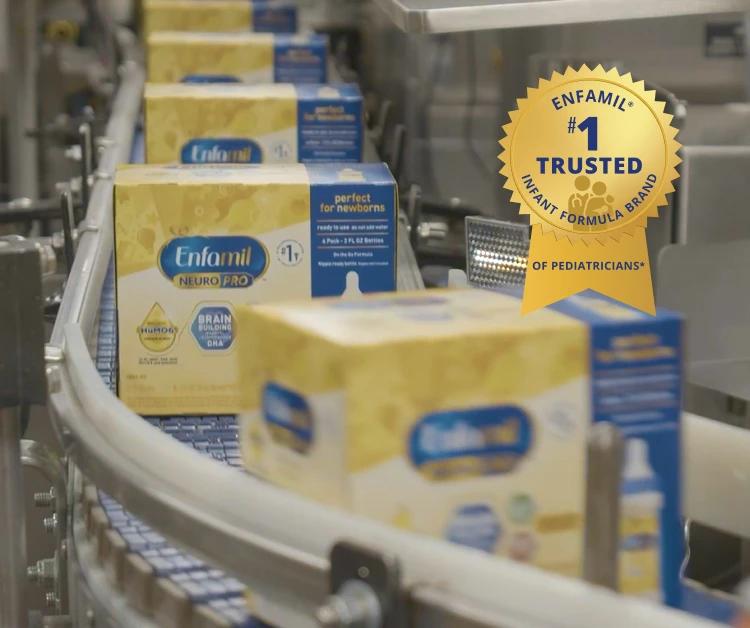
Our infant products undergo extensive quality and safety checks throughout the manufacturing process—from raw materials to finished product.

Each batch of our products is assured to meet our high quality and safety standards as verified by our proprietary Quality Systems that exist in every manufacturing facility. We distribute our products only if they pass our strict testing. We track the path of every ingredient in our infant and toddler products from its initial supplier through all processing stages until it reaches our consumer.

In addition, every product has a unique batch code that our consumers can easily identify and read. Should the need arise, our highly trained employees can use the unique batch codes to confirm the safety of our products.

Does Mead Johnson Nutrition Test Its Infant Formula Products for the Presence of C. Botulinum?

Our testing approach includes an early warning system for indicators of organisms such as botulinum, and it has been part of our standard protocol for years. We also conduct routine spore testing to ensure the quality and safety of our finished powdered products.

Ingredients and Heavy Metals

Ingredients FAQs

  • Fats are crucial for your baby’s growth, brain development, and immune system. Just like breast milk, about half the calories in infant formula come from fat.

    Many formulas use a blend of plant-based oils (often vegetable or seed oils) to provide essential fatty acids like linoleic acid (LA) and alpha-linolenic acid (ALA), which babies can’t make on their own. These fats help build healthy cells and support brain development.

    In infant formula, they’re carefully selected and precisely balanced to deliver the same types of healthy fats found in breast milk. That balance is guided by decades of research into what babies need to grow and thrive.

  • Carbohydrates are a key energy source for babies. In fact, about 40% of the calories in breast milk come from lactose, a natural milk sugar. Most standard infant formulas use lactose to mimic this.

    But some babies have trouble digesting lactose, or need a special formula for dietary reasons. In those cases, formulas may use other safe, well-studied carbohydrates like corn syrup, corn syrup solids, maltodextrin, or sucrose. These ingredients provide energy without lactose, and meet all FDA safety standards.

    It’s important to note that corn syrup used in infant formula is not the same as high fructose corn syrup found in sodas or candy. Corn syrup solids are a carbohydrate source for babies that may have issues digesting lactose.

  • We understand that many parents have questions about the recent recalls involving Kendamil, Nestlé, Danone, Lactalis, and BabyBio.

    We want to reassure parents and caregivers that none of our products are impacted.

  • No. The recalls issued in Europe and Canada are tied to an ARA oil supplier based in China. We do not source ARA oil from the impacted supplier or from any supplier in China.

    All Mead Johnson Nutrition products remain fully available in every market where we operate.

  • European rules require DHA (an omega-3 fat important for brain and eye development) in all infant formulas at a set minimum level. In the U.S., adding DHA is optional, though most formulas include it based on decades of supportive research.

    Experts recommend that DHA should account for 0.2% to 0.36% of total fatty acids in the formula. For example, Enfamil NeuroPro® has 0.32% of total fatty acids as DHA, similar to the average amount found in world-wide mature breast milk.

    European regulations have a lower maximum allowance for iron than formulas in the United States. This can lead to differing amounts between European and American-made infant formulas. Iron is an important nutrient that is crucial for health growth and brain development.

Heavy Metals FAQs

  • Heavy metals are naturally occurring elements present throughout the global food and water supply.

    Heavy metals are not ingredients in infant formula, nor are they added to any infant formula formulation.

  • Reports about heavy metals in our food supply often create unnecessary concern.  The truth is, trace amounts of heavy metals (including the scary sounding ones like lead or arsenic) occur naturally in soil, water and air.  

    Not only can they be found in breast milk, but they’re found in many foods that we eat, including fruits, vegetables, and grains.

    Complete elimination is not scientifically possible, which is why food safety agencies set regulatory limits to keep exposures well below harmful levels. The low levels commonly found in foods do not indicate a safety risk when products meet established standards.

  • Yes. We employ stringent testing protocols across all ingredients and finished products for heavy metals including mercury, cadmium, aluminum, lead, and arsenic.

    We are proud of our efforts to date to reduce the levels of unintended materials in our products, which meet all safety and quality standards set by U.S. and global regulatory bodies, including the rigorous EU regulatory limits for heavy metals.

    Baby Formula Safety: Testing, Standards & Trust

  • We test for a panel of heavy metals including mercury, cadmium, aluminum, lead, and arsenic. These tests are aligned with industry‑recognized methods and detection limits suitable for infant nutrition.


FDA Standards

The U.S. Food and Drug Administration (FDA) has very specific and rigorous manufacturing standards for infant formulas, toddler nutritional drinks and medical food products that we adhere to. 

All Mead Johnson products, including  Enfamil® NeuroPro®Enfamil® OptimumEnfamil® Gentlease®, Nutramigen®, Enfagrow® NeuroPro®, Enfagrow® PREMIUM Toddler Nutritional Drink, PurAmino™ Infant Formula, PurAmino™ Jr, and Enfamil® Enfalyte®, are in compliance with all FDA regulations.

Our products meet or exceed all infant formula requirements set out by the FDA, which are among the most rigorous in the food industry. The amounts of ingredients in Enfamil Infant Formulas are all within required guidelines established to ensure the safety and nutritional quality of infant formulas. We are committed to the most stringent manufacturing, packaging, and quality assurance procedures.

The FDA monitors the safety of dietary supplements once they have reached the marketplace. As the manufacturer, we are responsible for ensuring that our dietary supplements are safe and that the labels are truthful. We are committed to the most stringent manufacturing, packaging, and quality assurance procedures.

Infant Formula in the News

  • Mead Johnson Nutrition has an unwavering commitment to deliver products with the highest quality ingredients and nutritional standards. We look forward to working with HHS Secretary Kennedy and the FDA to continue providing access to proven, safe, high-quality and nutritious infant formula products backed by science to continually improve the health and wellbeing of infants and young children
  • We understand that many parents have questions about the recent ByHeart recall related to C. Botulinum. We want to reassure parents and caregivers that we do not have any affiliation with the two suppliers linked to the ByHeart recall.

    All Mead Johnson Nutrition products remain fully available in every market where we operate.

  • Mead Johnson Nutrition is committed to providing the highest levels of quality and safety for all our infant formula products as evidenced by the fact that parents and pediatricians have trusted our infant nutritional products for 120 years.

    We are disappointed the state of Florida announced results without sharing any data or testing methodology, which may unnecessarily scare parents and caregivers. These results are inconsistent with the findings consistently observed across thousands of tests we perform annually. We are concerned this testing, without the proper scientific, regulatory and environmental context, can lead to oversimplified statements, not representative of the product category or industry.

    It is important to note that many elements referenced in the announcement are naturally present in the environment, drinking water, the food supply chain, and cannot be completely avoided. These substances may be present in trace amounts in many food products, including infant formula and even human breast milk.

    We look forward to working with the state of Florida and the Department of Health to ensure parents and caregivers receive accurate information about infant formula.

Trusted by Families, Celebrated by Experts

*Among those who have a preference